

Today we are going to discuss body condition scoring in sheep. As someone who is breeding sheep, it is important to be able to know what sort of condition your animals are in at various stages of production—and what condition they should be in. If your sheep is either too fat or too thin this can predispose them to various different problems. For example, ewes that are both too thin or too fat might have trouble getting bred, and ewes that are too thin will have lower ovulation rates, so they might single instead of having twins or triplets.
For someone new to sheep, understanding what the different condition scores written in guides translate to in the field can sometimes be tricky. Most guides have a written description and drawings, but not images of actual sheep at various conditions. To complicate matters more, for wool sheep that aren’t freshly sheared, you have to body condition by feel rather than visually.
Luckily, with Katahdins, particularly in their summer coats, you can easily see their body condition. Being able to see what the different condition scores look like should help you to be able to imagine what you are feeling under thick wool. So today we are going to discuss how to body condition score and what you are feeling for. Then we are going to look at pictures of some of our ewes at various different condition scores.
Keep in mind while body condition scoring that it is not so much the exact number that you assign each animal, but the relative scores that matter.
Try to be consistent, but don’t stress about whether an animal is a 3.5 or a 4. The important information is whether your animals are too fat or too thin. At any given time, the majority of your sheep should score between a 2 and a 4. If your flock skews differently than that it would be a good idea to reevaluate your feeding program.
If you aren’t sure what scores your sheep should be at various cycle times, that’s ok. There are plenty of resources on the internet that will enlighten you. However, in a nutshell, they should be a 3 or 4 when you enter breeding season. They should remain this way throughout gestation and lambing. By the end of lactation they should not be any lower than a 2, and then should return to a 3 or 4 by the following breeding season.
If the majority of your ewes are more like a 2.5 instead of a 3 or 4 entering breeding season, they will likely benefit from being provided extra nutrition (called flushing) for about a month prior to putting the ram in through the first month or so of gestation.
Now, let’s get started!
To body condition score a sheep you are going to focus on determining the level of muscle and fat over/around the vertebrae in the loin area. The vertebrae in this area of the sheep’s body have a bony protrusion that sticks up (called spinal process). They also have short ribs attached to them (called transverse processes). The below picture shows where you are going to focus your efforts. In this picture, you can see where my fingers are under the edges of the transverse processes. This area right behind the rib cage and up to the spine is where you are mainly looking/feeling.

We are also including pictures of each body condition scores from behind as well as above. While technically their rump has nothing to do with body condition scoring, pictures are 2-dimensional, and from above it can be hard to see what we are looking at in the pictures. Looking at the ewes from behind will hopefully help you to visualize how the top of their back changes as their condition scores change. We are also including some side by side comparison pictures to help you see the differences you are looking for.
Body Condition Score 1—Emaciated
BCS 1 is a score that you never want your animals to be. Animals who are this score are too thin. At this score, you can easily feel each vertebrae and between them. There is no fat cover at all. The same goes for the transverse processes. The edges of the bones are all sharp and hard. You can easily feel each individual process, and can hook your fingers under them. With a recently sheared sheep or a shed Katahdin, you can see their spine. From behind can see how bony and angular this ewe’s butt is. In a freshly sheared or shed animal, you might even be able to see their ribs through their coat.
Now, you don’t want your animals to come out of lactation this thin, but sometimes it happens. If it does happen, then you need to make extra effort to put weight back on them before breeding season. You should also try to determine why they are this thin (parasites, bad teeth, age etc.). Can it be resolved or should be culled? You ideally want to improve their condition score to a 3 before you breed them again.
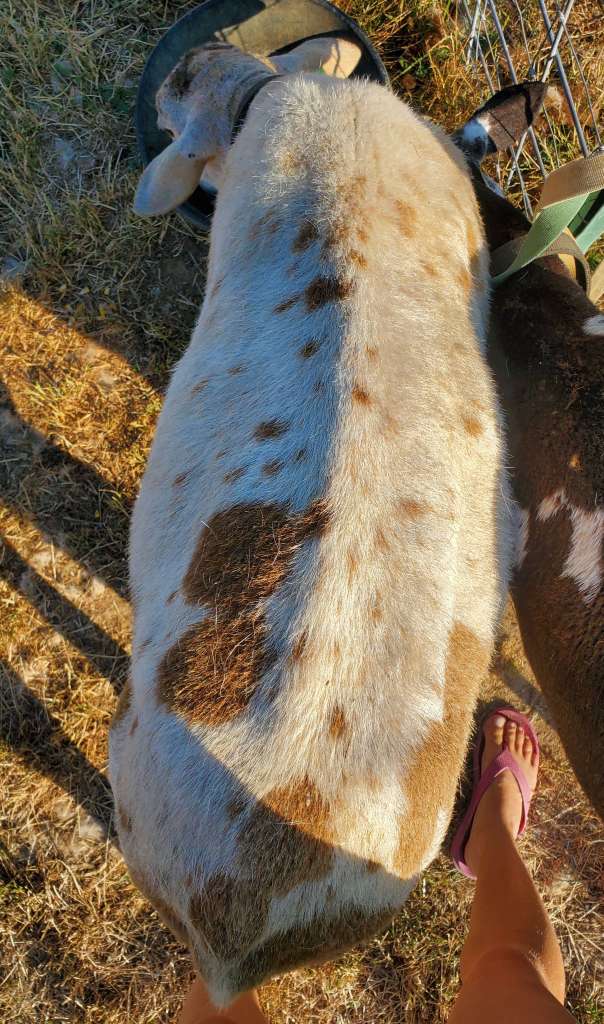


Body Condition Score 2—Thin
BCS 2 is an acceptable score for your sheep to be at certain points in the production cycle. A lot of ewes will come out of lactation as BCS 2. They are thin, but ok. Often, they put weight back on quickly once they stop making milk.
At this condition score, there isn’t really any fat cover, and the spine is still prominent. You can still feel the individual processes and put your fingers under the ends of the transverse processes if you push a little bit, but the bones are smooth. From the rear of the Katahdins, you can see that their spine is still prominent, but less so. Their rump is still angular, but smooth because there is a little bit of flesh covering the bones.

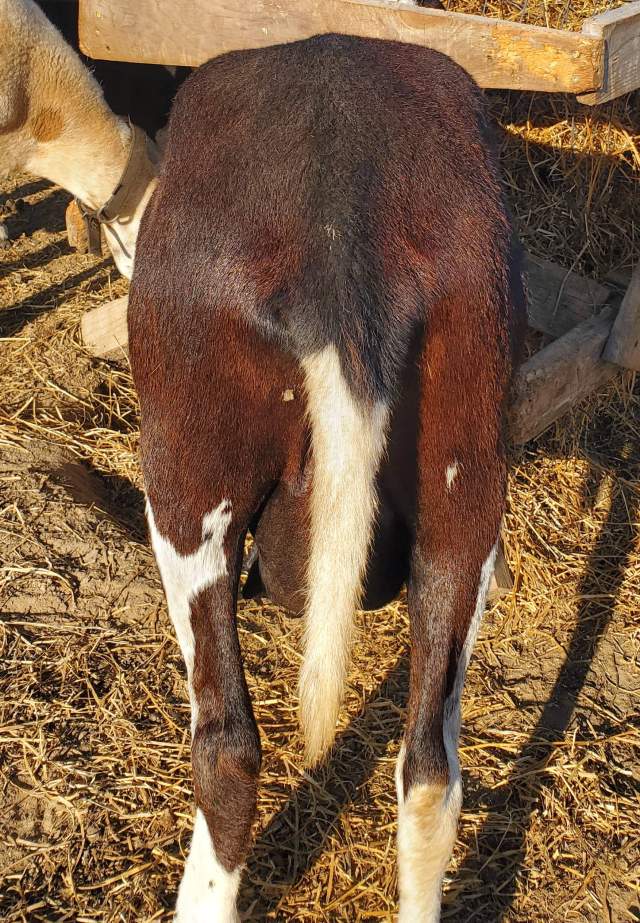

Body Condition Score 3—Just Right!
This score is considered ‘average’. Ewes of BCS 3 are the perfect weight for breeding. They are at the ideal weight for them to be throughout gestation. This is the target weight you want to have your ewes back to before putting the rams in.
At BCS 3, the spinal processes are smooth and rounded. They are no longer sharply poking out of your sheep’s back. You can’t feel individual processes unless you use pressure. The same goes for the transverse processes. They are smooth and have a layer of flesh over them, and you can no longer easily stick your fingers under them. You should just be able to feel the ends of the processes with light pressure. From behind, you can see that while their hip bones are still visible, they are smooth and obviously covered with some flesh. Their rump muscles appear full, and the top of their back is a smooth arc.
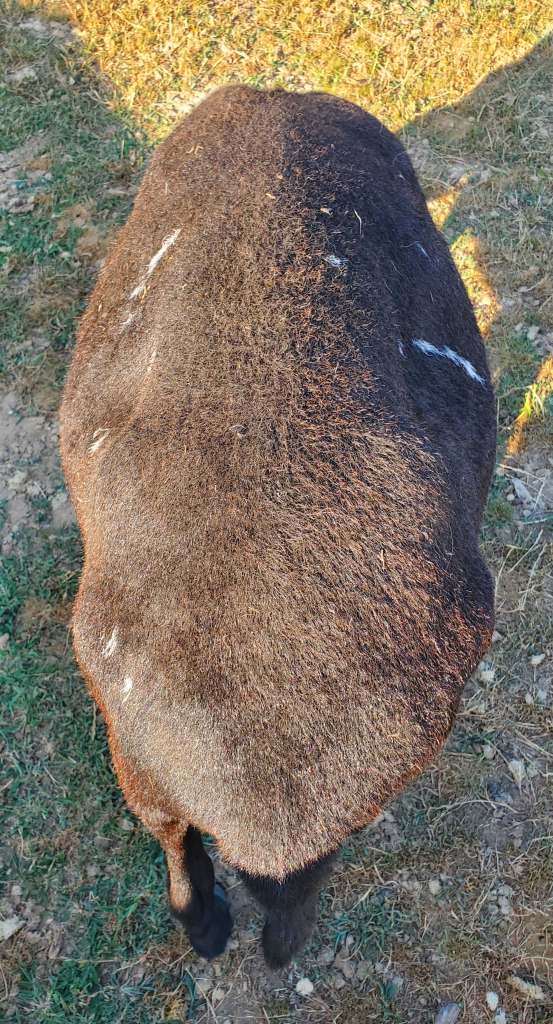


Body Condition Score 4–Fat
Once you get to a BCS of 4 your sheep are starting to surpass their ideal weight. If your ewes are a score of 4 or above and are not bred, lactating, or in with the ram to get bred, you can probably cut back their feed intake a bit. You really do not want them to be fatter than this, however this is a perfectly acceptable weight to be going in to breeding season at.
At BCS 4, you can only feel the sheep’s spine as a hard line if you push on their back. You can no longer feel the transverse processes at all. These sheep have full loin muscles, and a thick fat cover. From behind on our Katahdins, you can see how the bones are no longer visible, and their but is full and round.


Body Condition Score 5—Obese
Sheep at BCS 5 who are at a production stage where it is safe to do so should probably be put on a diet. Ewes that are obese can start to have production issues. Ewe lambs who are too fat can deposit excess fat in their udder resulting in poor milk production. Overweight ewes can have trouble conceiving and are also more prone to prolapse and pregnancy toxemia.
At this condition score, you can no longer feel their spine at all. Where their spine is located is only seen as an indent in the fat. The transverse processes are completely hidden. Just like the spine you cannot feel them at all. Everything is covered in a thick layer of fat. From behind you will be able to see how round and excessively fat their butt is. They will probably have large fat deposits around their tail.
Because none of my sheep are at this body condition score, I do not have any pictures to share with you. This level of obesity is most likely to be seen in wethers, ewes that didn’t get bred, or rams on small farms. Based on what you now know, you probably can imagine what a sheep of this BCS might look like.
We hope this helps you to objectively evaluate the condition of your flock so that you can make informed decisions about your feeding program, flushing, and breeding your ewes. If you would like to read more about this topic, or see drawings of the internal anatomy of the spine where you are body condition scoring, there are a variety of excellent university publications such as this one.
If you would like to read more articles like this one, don’t forget to sign up for our newsletter!
Please remember
The information provided is for general informational purposes only. All information on the site is provided in good faith, for general informational and educational purposes only and is not a substitute for professional advice. We make no representation or warranty of any kind, express or implied, regarding the accuracy, adequacy, validity, reliability, availability, or completeness of any information on this Site. Accordingly, before taking any actions based upon such information, we encourage you to consult with the appropriate professionals. We do not provide any kind of professional advice. THE USE OR RELIANCE OF ANY INFORMATION CONTAINED ON THE SITE IS SOLELY AT YOUR OWN RISK. View full disclaimer here.


